
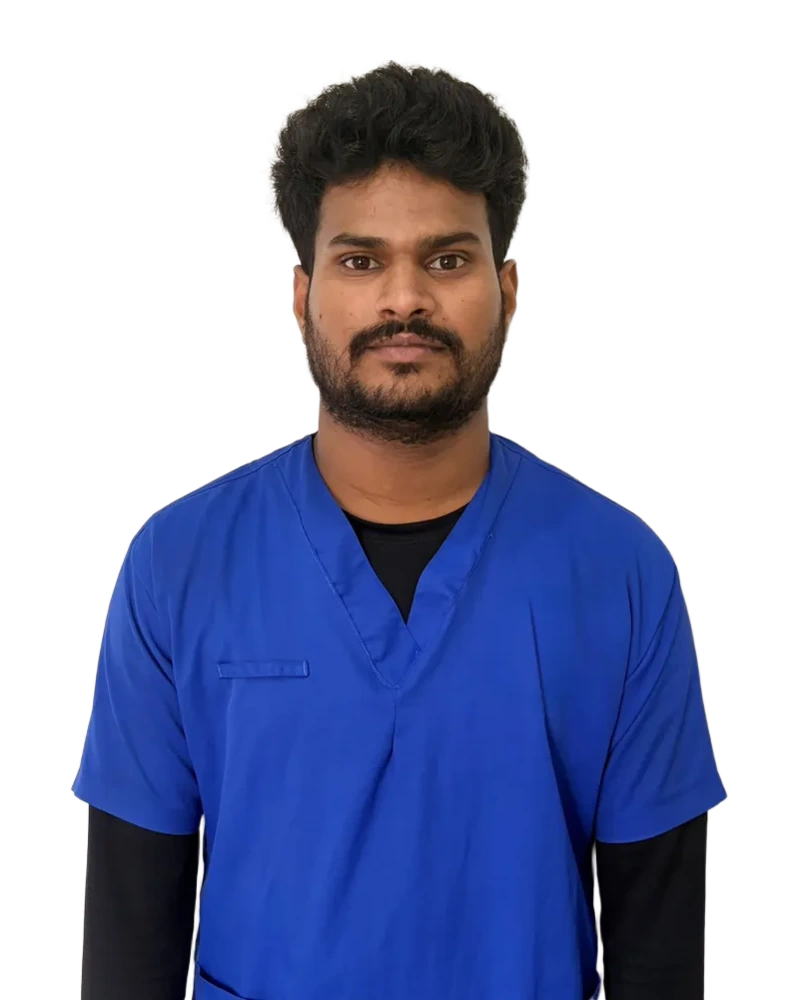
Education and a supplied four-year professional history
Bhanu Murthy’s BPT qualification provides the education context for his role in the PhysioGood physiotherapy team. The supplied work history records one year six months at Roopa Orthopedic Hospital, one year six months at Veritas Rehab and Hospital and one year at Anantha MK Institute of Medical Sciences. Together, those durations total four years. They are presented as professional background supplied for the profile, not independently verified employment dates or a statement of current affiliation with the named organisations.
An orthopaedic workplace name does not establish a postgraduate orthopaedic qualification. Bhanu Murthy’s listed degree is BPT, and the service discussion on this page reflects a general physiotherapy foundation rather than an unlisted specialism. Patients can still ask about appropriate musculoskeletal rehabilitation and practical movement support. The important next step is to match the requested care with the patient’s needs and the practitioner’s confirmed competence. A clear history helps provide context, but should not replace that individual suitability discussion.
Musculoskeletal physiotherapy as a care category
Musculoskeletal physiotherapy concerns movement involving joints, muscles and related structures. A patient may be seeking support because a familiar activity has become uncomfortable, an area feels stiff or they are uncertain about returning to a daily task. The same broad category can include very different situations, so a service label is only the beginning of an enquiry. An assessment needs to consider symptom history, existing medical advice, activity limitations and any relevant restrictions before an appropriate approach can be discussed.
Bhanu Murthy’s profile links to PhysioGood’s orthopaedic and musculoskeletal information because these general movement topics align with physiotherapy education. The link should not be read as an advanced specialist certification or a guarantee that every orthopaedic condition can be managed at home. Patients can explain the activity they want help with and ask whether the proposed visit is suitable. If the concern needs investigation, another practitioner or a facility with different resources, that pathway should take priority over arranging a convenient home session.
Knee movement and lower-limb function in daily life
For some people, knee difficulty first becomes noticeable when rising from a chair, walking farther than usual or using steps. Others are managing an existing diagnosis and want help understanding the activity recommended by their clinician. These are different contexts even when both enquiries mention knee pain. A physiotherapist needs to understand what the patient is currently experiencing, how it affects their day and what medical information is already available. A joint name alone cannot determine a safe exercise plan.
A suitable enquiry with Bhanu Murthy may include discussion of general joint movement, strength-related function and appropriate activity guidance. The actual support follows assessment and any relevant restrictions. This profile does not advise patients to start loading an injured joint or continue an activity despite concerning symptoms. A new injury, unexplained swelling or an abrupt loss of function may need medical review first. The aim is to help patients understand the appropriate next step for their situation rather than offer a standard routine for every knee complaint.
Shoulder, back and neck concerns at home
Reaching, dressing, lifting an everyday object and maintaining a comfortable sitting position can all reveal movement difficulties. A patient may describe the problem as shoulder stiffness, back discomfort or neck pain, but the activity gives additional context. During a suitable assessment, the physiotherapist can explore the pattern of symptoms and relevant movements. It is important not to assume that a posture explanation or a single exercise will fit every patient, particularly when there is a recent injury or a complicated medical history.
The upper-limb and back-and-neck links below offer service information patients can read before contacting PhysioGood. They are relevant discussion areas for a BPT physiotherapist, subject to the individual case and confirmed practitioner fit. Treatment choices should follow assessment rather than be selected from a list on a biography. Patients can ask what a proposed activity is intended to address and which precautions apply. A worrying change, significant trauma or a need for specialist assessment should be handled through the appropriate clinical route rather than delayed for a routine visit.
Post-surgical rehabilitation with the right context
A person recovering after surgery may have a clear rehabilitation recommendation but find travelling for support difficult. A home visit can be considered when the relevant care is suitable for that setting. The enquiry should include the type of operation, the current stage of recovery and the treating team’s instructions. These details matter because different procedures can have different limits on movement, weight bearing and activity. A general physiotherapy qualification does not justify applying a single recovery programme to every surgical patient.
Bhanu Murthy’s supplied hospital and rehabilitation experience provides background for discussing post-surgical enquiries, but the profile does not add procedure-specific achievements that were not supplied. The team needs to confirm whether the required service and practitioner fit are appropriate. Existing surgical advice should remain part of the plan, and follow-up appointments should not be replaced without a clinical decision. A possible complication, a new wound concern or a sudden change after surgery requires the relevant medical service rather than waiting for a normal home-care request.
Connecting rehabilitation with meaningful daily goals
A patient’s preferred goal may be practical and modest: preparing a meal more comfortably, moving around the home or managing a routine without as much uncertainty. Functional rehabilitation starts by understanding those priorities. The home environment can offer useful context about the task, the assistance available and the barriers the person notices. This makes it easier to discuss what support may be relevant, while remembering that the patient’s medical condition and current ability must guide the decision.
For care enquiries with Bhanu Murthy, a functional focus does not mean promising independence or setting a fixed recovery deadline. It means discussing activities in relation to the patient’s circumstances. Appropriate guidance should be understandable and open to questions. The patient may need clarification, a revised goal or another form of support as their situation changes. Family members can participate when the patient agrees, particularly to explain practical concerns, but the patient’s comfort and preferences should remain central to the conversation.
Home physiotherapy enquiries in Manikonda and nearby areas
People in Manikonda, Narsingi and Kokapet can enquire through PhysioGood about an appropriate home physiotherapy visit. These are service-area references, not clinic branches, personal addresses or a claim that Bhanu Murthy covers every request in those locations. The team checks the precise address, the requested support and practitioner availability before confirming arrangements. Patients should describe their locality clearly so that coverage can be considered alongside the clinical needs, rather than assumed from a neighbourhood name alone.
The purpose of home care is to reduce unnecessary travel where treatment in the home is suitable. This can be helpful when a patient finds transport, waiting or getting in and out of a vehicle difficult. It does not remove the need for hospital care, investigations or other necessary appointments. Before agreeing to a service, ask about the relevant price and practical arrangements. PhysioGood aims for affordable, patient-focused support, while recognising that the appropriate setting and a clear plan matter more than convenience alone.
Enquiring about care with Bhanu Murthy Pendyala
The profile’s request button lets patients identify Bhanu Murthy in their enquiry. Telephone and WhatsApp contact are also available through the PhysioGood care team. A brief description of the difficulty, the patient’s location and important medical instructions gives the team a starting point. There is no need to publish sensitive records in an open message. The team can explain the appropriate way to share additional information as it reviews suitability and checks whether the requested practitioner can be arranged.
The supplied education, experience and service discussions here are intended to help patients make an informed choice about the next conversation. They are not a promise of a cure, a guaranteed result or a substitute for assessment. Patients looking for a home physiotherapist in Hyderabad can ask about the proposed support, relevant precautions and costs before a visit is confirmed. If the patient needs another provider or treatment setting, that should be discussed clearly. The priority is an appropriate rehabilitation pathway rather than an unsupported claim of universal expertise.