
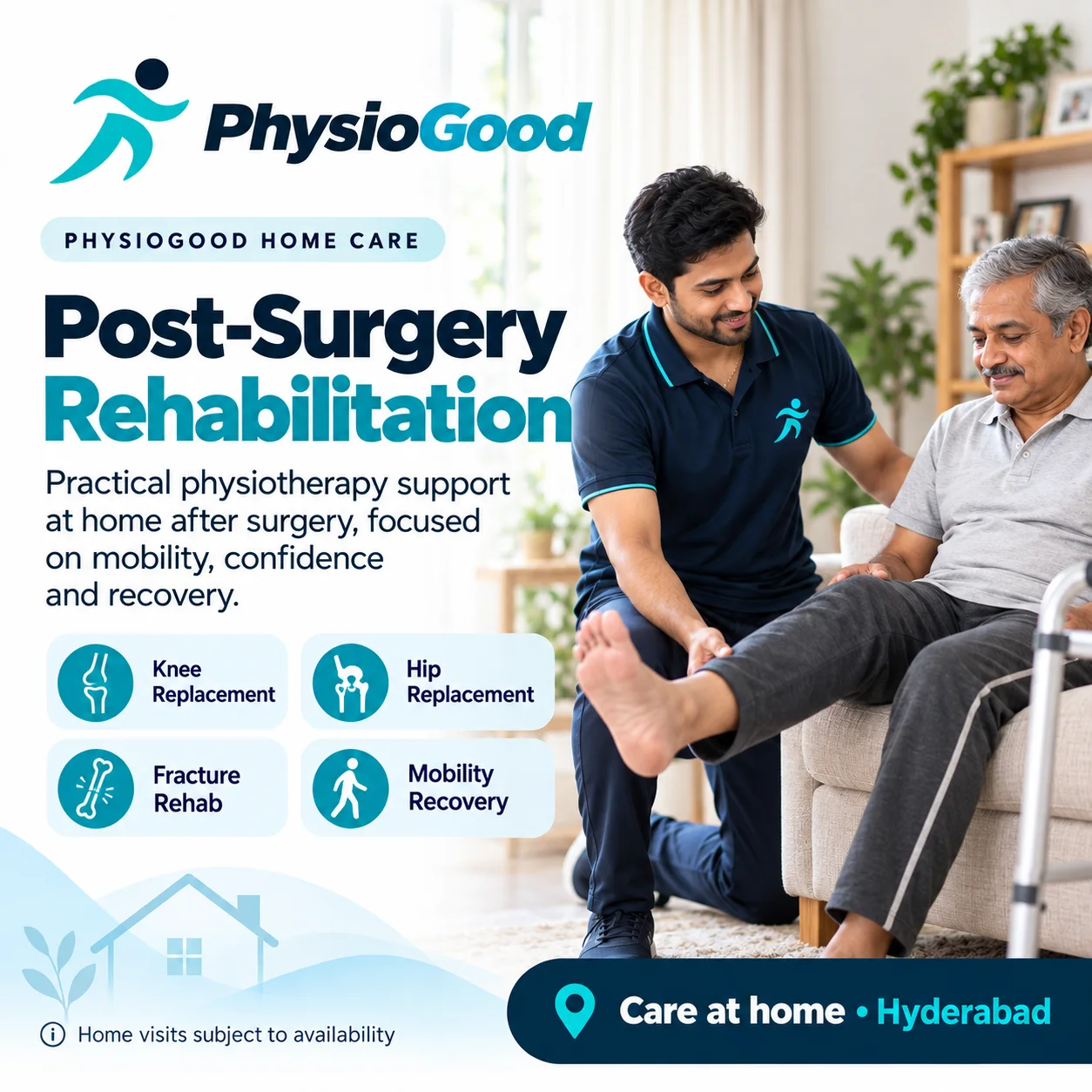
A home-visit care option
Recovery after surgery
Share your current stage of recovery and relevant advice from your surgeon.
Explore this serviceCare option / 04
Recovery is not a race. Home physiotherapy can help you practise meaningful movement while respecting your surgeon’s instructions and individual recovery.
A measured return to movement following surgery, guided by your clinical advice. Care is individual; a physiotherapist first considers your situation and goals before discussing an appropriate plan.
A home-visit care option
Share your current stage of recovery and relevant advice from your surgeon.
Explore this serviceWhat you can ask about
These examples can help you describe your situation. They are not diagnoses or a promise of a specific treatment; suitability, relevant expertise and availability must be confirmed before care is arranged.
PHYSIOGOOD CARE GUIDE / HYDERABAD
A practical guide to understanding your next step
Published by PhysioGood. General patient information, not a diagnosis or an individual exercise prescription. Supporting sources are listed below.
Returning home after surgery often raises practical questions about standing, walking, dressing and exercise. Post-surgical rehabilitation should respect the procedure, the stage of healing and your surgical team’s instructions. This guide explains what to discuss when enquiring about post-operative physiotherapy at home in Hyderabad, without prescribing a generic recovery schedule.
Post-op physiotherapy is rehabilitation after an operation. When home care is suitable, a physiotherapist can discuss approved movement and daily activities while following your surgeon’s restrictions and stage of healing.
An operation name is only the beginning of a rehabilitation plan. The exact procedure, any complications, the surgeon’s precautions and your general health can affect what is appropriate. Two people who both had knee surgery may have different weight-bearing instructions, movement restrictions or review requirements. Do not copy someone else’s programme because the operation sounds similar.
Share your discharge summary, current instructions and upcoming follow-up arrangements before exercises are discussed. If instructions are unclear or conflict with advice you remember, the clinician may need clarification from the surgical team. Physiotherapy should work within the medical plan, not overrule it. The website cannot determine when a healing structure is ready for a particular movement, resistance level or daily activity.
After knee replacement, common concerns include getting in and out of a chair, using the bathroom, walking with an aid and managing the movements advised by the surgical team. Pain, swelling and confidence may influence how these tasks feel. The aim of a first physiotherapy conversation is to understand what you can currently do and what support or precautions are in place.
Assessment may consider movement, selected muscle activity, walking and everyday transfers, where appropriate. Guidance can then address the individual starting point and agreed goals. This is not a promise of a particular knee-bending measurement or an unassisted walking date. Follow prescribed wound, medicine and follow-up instructions, and ask the treating team about changes that seem unusual or are getting worse.
Hip replacement rehabilitation may involve learning how to move around the home while respecting the precautions provided for the operation. Your instructions may include guidance about weight bearing, particular movements or the use of an aid. Do not assume that a precaution mentioned online applies to your procedure, or that it can be ignored because another person was told something different.
A physiotherapist can discuss suitable transfers, walking and strengthening in relation to those instructions. Chair height, bed access and the route to a bathroom may matter in a home setting. Tell the clinician which activities are challenging and whether help is available. Equipment advice should reflect your circumstances; buying a device in advance does not establish that it is needed or safe for you.
Physiotherapy for post-fracture stiffness may involve carefully progressing movement after a cast is removed, when the treating clinician has confirmed the necessary precautions. A home physiotherapist needs to understand healing status, pain and any weight-bearing or movement restrictions before recommending activity. Stiffness is not a reason to force a joint through its range or disregard fracture-care advice.
Rehabilitation following a fracture depends on where the injury occurred, how it was treated and what the medical team has confirmed about healing and permitted activity. Some fractures are treated surgically, while others are managed without an operation. Stiffness after a period of immobilisation can be one concern, but the removal of a cast does not automatically permit unrestricted exercise or loading.
Share current movement and weight-bearing guidance, including any instructions about a splint or brace. Physiotherapy may consider appropriate mobility, strength and functional use as the plan allows. A painful or swollen limb should not be forced through movement simply to regain range quickly. New deformity, severe worsening pain or loss of function requires medical advice rather than an unsupervised exercise trial.
Ligament reconstruction and tendon repair can have procedure-specific protection requirements. ACL, meniscus and tendon-related surgery should not all be treated as the same knee or limb rehabilitation problem. Some movements or resistance exercises may need to be limited at particular stages. The surgeon’s protocol and clinical assessment guide progression, not a universal online timeline.
Explain the procedure and bring the protocol if one was supplied. The physiotherapist can discuss the allowed starting activities and how progress will be reviewed. Everyday demands such as work, carrying objects or caring for family may need adaptation while healing structures are protected. Feeling stronger or having less pain does not by itself establish readiness to return to unrestricted activity or sport.
After shoulder surgery, people may have questions about a sling, dressing, sleep positions and when arm movement is permitted. Rotator cuff repair and other shoulder procedures can have different restrictions. Do not remove prescribed protection or start overhead exercise because an online video describes a routine as gentle.
An assessment-led discussion can consider comfort, practical tasks and exercises allowed by the current instructions. The distinction between assisted, active and resisted movement may be important, so ask the clinician to explain any unfamiliar term. Advice about work, driving or lifting should account for the procedure and treating team’s recommendations. The home programme should be understood and demonstrated appropriately rather than interpreted from this general information page.
Post-operative rehabilitation may support a measured return to meaningful movement after a range of procedures. Relevant goals can include changing position, getting up safely, walking a short indoor route or gradually rebuilding strength. The appropriate focus depends on why the operation was performed, current medical stability and any restrictions.
Movement and strengthening are not interchangeable with doing more at every session. The starting task, amount of assistance and progression should reflect assessment and response. If your operation involved the spine, chest, abdomen or another area with specific precautions, explain this clearly when enquiring. The team must consider whether the required expertise and an appropriate home-care setting can be confirmed before offering a plan.
Prepare your discharge documents, relevant prescriptions, surgical instructions and a list of practical questions. State what help you currently need and whether you use crutches, a walker, a brace or another support. You do not need to test your limits before the visit to show progress. Knowing the current level of assistance helps the clinician plan a suitable assessment.
The visit may involve discussion of symptoms, available medical information and selected movements or tasks. Consent, comfort and safety guide the process. The clinician should explain which activities are being assessed and why. If a precaution is uncertain or a symptom requires medical attention, clarification or referral may take priority over completing an exercise session.
The home environment can reveal challenges that are easy to overlook in a general recovery leaflet. A low chair, a long route to the bathroom, stairs or limited space to use a walking aid may affect daily routines. Discuss these details before a home visit is confirmed, including lift access and whether someone can assist when needed.
Small adjustments may make a prescribed routine more practical, but not every difficulty can be solved with a home session. Some situations require different equipment, further training or more support. Family members should not improvise lifting techniques or pull on a operated limb. Ask for guidance within the clinician’s scope, and raise any task that remains unsafe or physically unmanageable.
Agree on useful indicators of progress, such as a change in assistance needed for a transfer or improved ability to perform a permitted exercise. Goals can be reviewed alongside symptoms and the surgical team’s guidance. Recovery varies; the site cannot guarantee a number of sessions, a pain-free date or return to normal activity within a fixed period.
Report persistent increases in symptoms, changes in the wound or difficulty following the home plan. The clinician may modify the task, seek medical clarification or recommend review. Decisions about wound treatment, medication and the need for further investigations belong with the appropriate medical professional. Rehabilitation should support your recovery plan, not replace ongoing surgical follow-up.
When enquiring about knee replacement rehabilitation, hip replacement rehabilitation or physiotherapy after surgery in Hyderabad, provide the operation type, approximate stage of recovery and your locality. You may be returning home in Kondapur, Gachibowli, Banjara Hills, Jubilee Hills or another Hyderabad area. The team checks exact address coverage and clinician availability individually; locality guides are not guarantees of a visit.
A request through the website starts a conversation rather than confirming an appointment or treatment plan. Ask what information is needed to establish suitability and whether your discharge instructions should be reviewed before the visit. If you want a video follow-up, check whether it can appropriately address the intended question. Some post-surgical assessments and hands-on safety needs require in-person care.
Follow the warning-sign advice given by your surgical team. New chest pain, severe breathing difficulty, uncontrolled bleeding or a serious acute change requires urgent medical help, not a routine physiotherapy response. A fever, concerning wound change, a newly swollen painful limb or rapidly worsening symptoms should be discussed promptly with the treating medical service. This general list does not cover every possible complication.
Do not assume a new symptom is a normal part of rehabilitation or attempt to exercise through it. If you are unsure how urgent a change is, contact an appropriate medical professional. PhysioGood is not an emergency or wound-care service, and this page cannot assess post-operative complications.
HOME VISITS IN HYDERABAD
PhysioGood offers home physiotherapy across listed Hyderabad localities. A locality page is a starting point, not a coverage guarantee: the team confirms availability for your exact address before a visit is agreed.
Exact-address coverage is confirmed with the care team, along with suitability and availability.
GOOD TO KNOW
The timing depends on your procedure, medical stability and surgical instructions. Share your documents and ask about suitability rather than assuming an immediate home visit is appropriate. Your treating team’s recommendations should guide the next step.
If a protocol or written precautions were supplied, keep them available. They can guide permitted movements and progression. A clinician may need clarification if instructions are missing or inconsistent; this is safer than filling the gap with a generic programme.
You can ask about practical arrangements, but a session quantity is not a clinical recommendation. The appropriate plan and review schedule depend on assessment. An enquiry does not guarantee a course of treatment or a particular recovery result.
Not necessarily. Healing, function, procedure-specific criteria and medical guidance all matter. A return-to-activity decision should follow appropriate review rather than pain alone. Discuss the demands of your sport or work before changing your programme.
FURTHER READING